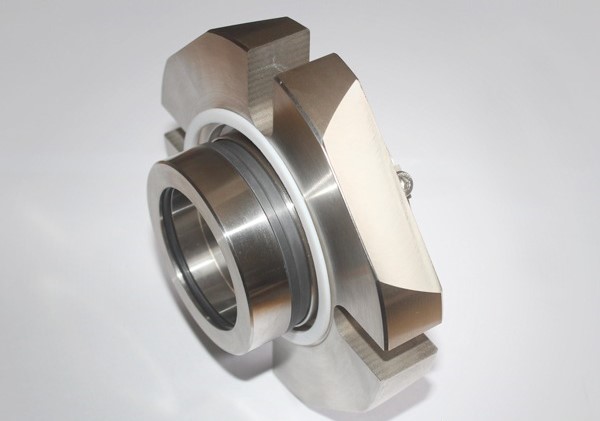

Mechanical seals come in many different shapes and sizes. Some are designed to perform well in high temperature applications, while others are built to seal high pressure or hazardous fluids. In this article we will dive into a few different categories of mechanical seals and highlight their strengths and weaknesses.
To preface, most of the namesakes of these seal types refer directly to the secondary sealing elements, rather than the seal faces. Two of the most popular categories of mechanical seals are pusher seals, sometimes referred to as o-ring pusher seals, and bellows seals.
Here for the first time? Not sure what a mechanical seal is? Learn more here.
Pusher seals
Pusher seals, often referred to as “o-ring pusher seals” or more simply “o-ring pushers”, are a type of mechanical seal design that utilizes an o-ring as the secondary sealing element or device. This o-ring is classified as secondary because the main sealing action happens at the seal faces. This o-ring is “pushed” by a combination of springs and the fluid pressure in the seal chamber to maintain sealing against the seal face and other seal components. As the seal faces wear, the o-ring moves axially to maintain a liquid tight seal against these components.
The benefits of pusher seals is that they typically can seal higher pressure fluids, when compared to other seal types. On their own, o-rings are capable of sealing relatively higher pressures.
Some of the downsides of pusher seals is that they are limited to relatively lower temperature applications, based on the temperature limit of the elastomer or o-ring material used. Additionally, o-ring pusher seals can hang-up and cause leakage in fluid applications that contain debris or fluids that may change with temperature (i.e. coking or setting up). Last, o-ring pusher seal assemblies typically have more parts when compared to other seal types, such as metal bellows.
Bellows seals
The term “bellows seals” encompasses a wide range of materials and technologies, however, the operating philosophy and mechanisms are somewhat consistent. As opposed to pusher seals, bellows seals use a bellows, typically made from metal or an elastomer, as the secondary sealing element. This replaces the o-ring described above in the o-ring pusher seal type.
Metal bellows
Metal bellows seals are one type of bellows seal. They utilize a thin metal material that is either formed or welded to form a liquid-tight assembly that resembles an accordion or bellow.
The benefit of metal bellows seals are undoubtedly their temperature ratings. Metal bellows seals can be installed in pump applications in excess of 700 F (371 C)! Additionally, different types of metallurgy can be used for the bellows material, adding flexibility for use in different applications, such as that in corrosive fluids.
Metal bellows fall short when it comes to pressure ratings and typically cannot seal up to the same pressures, when compared to pusher seals.
Elastomer bellows
Elastomer or “rubber” bellows are the last type of bellows seal that we will feature in this article. Unlike the metal bellows seals, elastomer bellows seals use a folded elastomer, or bellows, as the secondary sealing element. Bellows come in many materials, ranging from Buna-N to fluoroelastomer (viton). Typical designs feature one large coil spring that helps to hold the seal faces together.
There are a few benefits of elastomer bellows seals, one being their low cost. Because elastomer bellows seals are typically cheaper (when compared to other mechanical seal types) they are often specified by pump OEMs who manufacture large volumes of pumps. Additionally, the bellows of elastomer bellows seals are flexible and can often makeup movements due to pump misalignment. Last, due to the lack of a pusher o-ring, bellows seals work well in applications where there are known to be debris or abrasives because they won’t hang up like a pusher seal might.
Elastomer bellows are temperature-limited depending on the elastomer type.
Teflon (PTFE) bellows
Believe it or not, there are some bellows seal designs that utilize teflon or PTFE (Polytetrafluoroethylene) as the material for the bellows themselves. As one might expect, teflon bellows are best used in extremely corrosive applications due to the chemical resistive properties of teflon. This may include sealing acids, brines, caustics, or organic compounds.
Teflon bellows fall short in their temperature ratings, which are limited to up to 250 F (120 C).
Dry gas seals (for process pumps)
Dry gas seals for pumps, inspired from dry gas seals used in compressors, are cartridge mechanical seals, most often dual pressurized, that utilize a dry gas, typically nitrogen, as a barrier fluid to create a positive seal. The barrier fluid gas is continuously injected into the seal at a pressure higher than the seal chamber pressure to create a positive flow of gas into the seal chamber and pump. At the same time, the seal faces, that are etched with spiral grooves, rotate and create lift and space separation between the faces with the help of the injected barrier gas. When operating as designed, the nitrogen consumption is relatively low and there is no leakage of process fluid to atmosphere.
Dry gas seals for pumps work well when used in applications for “lighter” fluid products or fluids with high vapor pressures. Also, because of the dual seal design, these seals are best in hazardous applications where zero emissions to atmosphere are required.
The downsides of dry gas seals for pumps is that they require additional support systems (API Plan 74) and utilities (N2) when compared to single cartridge seals. As such, they require a reliable nitrogen (or other inert barrier gas) supply to ensure proper function. Also, with this type of seal design the barrier gas does make its way into the process, usually negligible amounts during normal operations. If the seal is damaged, the barrier gas consumption can be excessive, thus leading to more gas in the pump and process. This can be adverse in applications that are sensitive to gas entrainment.
In summary, mechanical seals come in a variety of shapes, sizes and types. Which seal type is your favorite? Contact us and let us know!